
- Homepage
- Brand
- Manufacturer
- Model
- Ac-15 (25)
- Ac-25 (13)
- Acoustage (7)
- Adio Air Gt (11)
- Brian May Deacy (10)
- Celestion G12t-75 (14)
- Cube Street Ex (7)
- Fly 3 (13)
- G12m (7)
- G12m-65 (7)
- Jazz Chorus (7)
- Pathfinder 10 (7)
- Peavey Vypyr X 2 (7)
- Spark 40 (8)
- Spark Go (8)
- Super Reverb (14)
- Twin Reverb (9)
- Vintage 30 (14)
- Vox Brian May Mv50 (7)
- Yamaha Thr10ii (9)
- Other (4313)
- Product Line
- Suitable For
- Venue Type
AMPLIFIER Klipsch 2.1 ProMedia Upgrade Subwoofer Speaker Amp 1st Gen Replacement
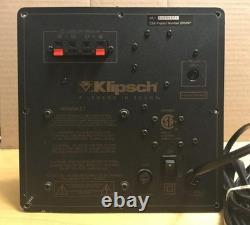


This plate amplifier mounts to the back of a ProMedia 2.1 subwoofer enclosure (not included). The amplifier works great, has upgraded quality parts, and runs cooler. The fan is internal once the amplifier is installed into your enclosure. You reuse your 2.1 subwoofer enclosure. This amplifier has better performance than the ProMedia 2.1 systems produced since 2012, with stronger bass (including headroom) and better presence in the midrange. Klipsch's Lumina specs still do not match what the company cited for its first generation's power 98 dB vs.
106 dB nor frequency range minimum 40Hz vs. The new Lumina adds non-audio features: a computer interface, LED adjustable lighting and adjustable-angle satellite stands. The successive 2.1 versions from 2012 through 2025 steadily reduced content and power to target a broader market at a lower price point. The Lumina falls off (-6dB) by 40 Hz. This listing's first generation version uses a pair of individual power transistors (TIP 41C TIP 42C MOSFETs) for each satellite channel, while the last ProMedia 2.1 uses a single amplifier-on-a-chip to power both channels (TDA7265).
(Each transistor in the pair is rated for 65 watts max). He second generation ProMedia (2012 to mid-2018) uses a single TDA7265B chip for both satellite channels, rated for 25 W/channel at 1% distortion, or maximum 30 watts at 10% distortion (which is audible). That switch after the first generation ProMedia 2.1 to a single chip to replace what four discrete MOSFETs produced means pushing power through a noticeably smaller package. He last generation uses a less expensive TDA7265 chip, rated for just 20 watts/channel at 1% total harmonic distortion (THD), or 25 watts maximum at 10% THD. So each generation has marked a decrease in cost and performance.
You want your amplifier to have plenty of headroom to be able to effortlessly reproduce momentary peaks of demand without distorting or having to compress the sound. For comparison, Klipsch's 470W ProMedia 5.1 system of the same, early 2000s era uses four MOSFETs per channel, 24 in all, for 60 watts per channel to the satellites. The early, MOSFET-powered ProMedia 2.1, 4.1 and 5.1 all share pleasing clarity.
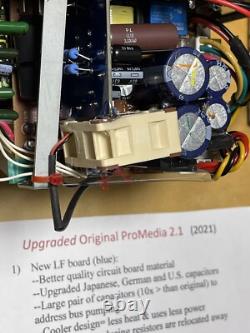
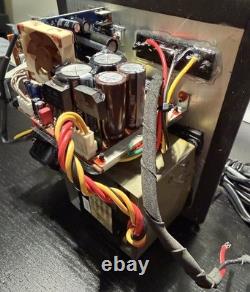
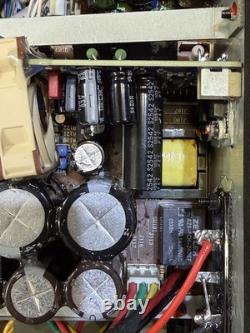
Upgraded parts: This has a designed-in-2020 (made in 2026) low frequency (LF) amplifier board with 57 new components. It produces less heat and has better quality Japanese, U. A pair of 1000uF low ESR capacitors have ten times Klipsch's original design capacitance, to address a class D design weakness of bus pumping.
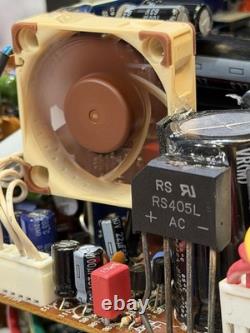
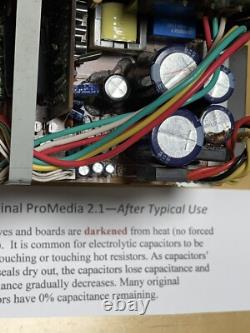
The original capacitors were next to a hot resistor, so they usually have lost even the original capacitance. The new design has five improvements: 1 a pair of power resistors waste less energy and produce less heat, 2 are far from the capacitors, 3 the capacitors are much better quality, and two are far larger, 4 the board itself is much better quality, and if selected, 5 a fan keeps heat from cooking components. The power supply has twenty new components, including all-new and upgraded electrolytic capacitors. The two satellite circuit boards each have an upgraded resistor to address a design flaw that can cause a channel to short, possibly damaging a speaker.
If your ProMedia has one channel dead, 1 check if you can hear both channels through headphones connected to the jack in the side of the preamplifier volume control pod. If sound is present, your signal source is good.Do not connect the good channel's speaker to the dead channel for the next test, or you could burn that speaker out, too! Rather, 2 connect the dead channel's speaker to the channel that works (left or right) to see if it works there.
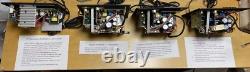
If a speaker tests dead (burned coil), I also have replacement ProMedia 2.1 satellite speakers available. An internal Noctua 150,000-hour cooling fan evens out internal temperatures, speeds removal of heat by the aluminum plate and the enclosure, and extends component life in the power supply and LF amplifier. Photos show original, charred amplifier boards without cooling and show the new (red or blue) circuit board sitting next to the old, and show the new board after installation.
Caution: Not every problem with the popular ProMedia 2.1 system is due to an amplifier problem. Some systems break from damage to the control pod cable; often noticeable by the system working intermittently as the cable is flexed near its plug, or if you can see one of the pins in the plug is bent over.Others have a failing 6.5 speaker. You can remove the metal grill, and touch the foam surround. If it is brittle or sticky or even has holes and tears in it, you know it is time to replace it. I also have do-it-yourself refoam kits in my store.
Avoid a mismatched 8-ohm or 4-ohm generic replacement. 4-ohm replacements can damage the amplifier.
8-ohm replacements may reduce performance by 25%. Klipsch's 6.5 speakers for systems made since 2018 (Generations 3 & 4) use a lighter magnet for their speaker, and the speaker does not fit in the first generation's enclosure opening.Both of the versions made until mid 2018 use the same control pod with a round, 6-pin mini-DIN plug, fit the same enclosure, and connect to the same satellite speakers. (A control pod, needed for operation, is not included here). The newest ProMedia 2.1 systems use a serial-type plug with parallel rows of pins. This earlier, first generation version uses a heavier, more expensive transformer power supply.
The easiest way to recognize it is by its rocker on/off switch for power, located next to the power cord. This system draws 0 watts when turned off. The original design draws 18-20 watts when turned on (no volume), or 24 VA. With the improved LF board, the amplifier draws 15-16 watts when turned on. The panels weigh nearly 8 pounds.
Version, I recommend re-using my boxes and packaging. Total System Frequency Range: 32Hz-20kHZ.
Peak Amplifier Headroom: 2 X 35 watts-satellites 1 X 130 watts-subwoofer. Satellite Impedance: 4 ohms minimum.
Amplifier: Digital linear hybrid amplifier; discrete MOSFET output power section. Subwoofer Limiter: Protective limiter function protects the driver and amplifier from extremely high volume playback.Second Generation Specs (2012 data). Amplifier: High-efficiency power supply and linear amplifiers designed for uncompressed full power sound.
Third Generation: ProMedia 2.1 BT (Bluetooth) Specs (2017). Total System Power: 100 watts continuous/200 watts peak at.
260 watts short-term peak power. Satellites: 18 watts/channel continuous at. 26 watts/channel short-term power at. Subwoofer: 65 watts continuous at.Fourth Generation: ProMedia 2.1 THX (2023) Data not from Klipsch, but based on components used. Satellites are driven by a TDA7265 chip rated for 20 watts/channel at 1% THD, or 25 watts/channel at 10% THD.
Subwoofer is driven by a TDA7294 chip rated for up to 100 watts THD is specified at. 1% at up to 50 watts.